
Definition with Real-Time Examples (Structured Guide)
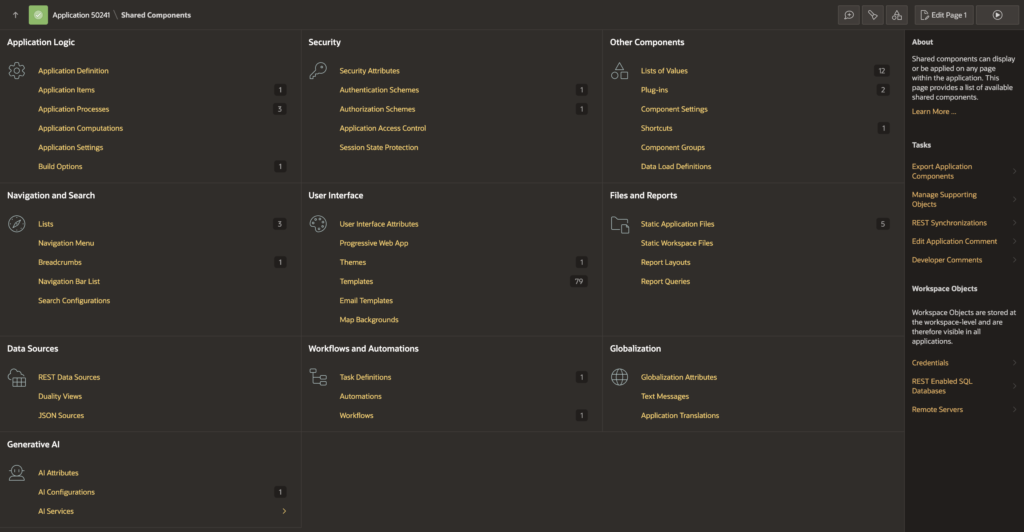
In Oracle APEX, Shared Components act as a central reusable repository where you define logic once and use it across the application.
👉 Think of it as the backend engine that powers all pages efficiently.
⚙️ 1. Application Logic
🔹 Application Definition
Definition: Controls overall application-level settings and behavior.
Example: Setting application name, enabling debug mode, or configuring session timeout.
🔹 Application Items
Definition: Global variables accessible across the entire session.
Real-Time Example: Store G_ORG_ID when a user selects a department, and automatically filter all reports based on it.
🔹 Application Processes
Definition: PL/SQL logic executed at application-level events.
Real-Time Example: Log user login details (IP, timestamp) into an AUDIT_TRAIL table after authentication.
🔹 Application Computations
Definition: Automatically assign values to items using logic or queries.
Real-Time Example: Set default organization or user role when session starts.
🔹 Application Settings
Definition: Configurable key-value pairs used across the app.
Real-Time Example: MAINTENANCE_MODE = Y redirects users to a maintenance page without code changes.
🧭 2. Navigation and Search
🔹 Lists
Definition: Reusable navigation structures used for menus and UI elements.
Real-Time Example: Show “Admin Dashboard” only for users with ADMIN role.
🔹 Navigation Menu / Bar
Definition: Defines main navigation structure (sidebar/top menu).
Real-Time Example: Sidebar menu for modules like Employees, Reports, Dashboard.
🔹 Search Configurations
Definition: Defines how global search works across the application.
Real-Time Example: Search both PROJECT_NAME and TASK_DESCRIPTION from a single search bar.
🔗 3. Data Sources
🔹 REST Data Sources
Definition: Connects application with external APIs.
Real-Time Example: Fetch live currency exchange rates for invoice calculations.
🔹 JSON Sources & Duality Views
Definition: Work with JSON and relational data together.
Real-Time Example: Product catalog where each product has different attributes (size, voltage, color).
🔐 4. Security
🔹 Authentication Schemes
Definition: Defines how users log in.
Real-Time Example: Login using Azure AD or database credentials.
🔹 Authorization Schemes
Definition: Controls access to components based on rules.
Real-Time Example: Only users with role “Manager” can approve expenses.
🔹 Session State Protection
Definition: Prevents URL tampering and unauthorized access.
Real-Time Example: Prevent users from changing record IDs in URL to view others’ data.
🎨 5. User Interface
🔹 Themes & Templates
Definition: Controls application look and layout.
Real-Time Example: Customize footer to include company disclaimer across all pages.
🔹 Email Templates
Definition: Reusable HTML email formats.
Real-Time Example: Password reset email with dynamic placeholders like #USER_NAME#.
⚡ 6. Workflows and Automations
🔹 Workflows
Definition: Multi-step business process automation.
Real-Time Example: Hire request → Manager approval → HR approval → Payroll entry.
🔹 Automations
Definition: Scheduled or event-based background jobs.
Real-Time Example: Weekly job to send overdue task reports to managers.
🧩 7. Other Components
🔹 Lists of Values (LOVs)
Definition: Reusable dropdown data sources.
Real-Time Example: Show only active projects in all dropdowns automatically.
🔹 Plug-ins
Definition: Extend APEX with custom or third-party features.
Real-Time Example: Google Maps plugin for selecting delivery location.
🔹 Data Load Definitions
Definition: Defines logic for importing data files.
Real-Time Example: Upload Excel file to insert employee records into database.
🤖 8. Generative AI
🔹 AI Services
Definition: Integration with AI/LLM services.
Real-Time Example: Analyze customer feedback sentiment using AI.
🔹 AI Configurations
Definition: Define AI behavior and prompts.
Real-Time Example: Convert natural language like “Show last month sales” into SQL query.
📁 9. Files and Reports
🔹 Static Application Files
Definition: Store JS, CSS, and images for the app.
Real-Time Example: Upload custom JavaScript for UI enhancements.
🔹 Report Layouts
Definition: Templates for generating PDFs or documents.
Real-Time Example: Generate employee certificates or invoices in PDF format.
🌍 10. Globalization
🔹 Text Messages
Definition: Store translatable text messages.
Real-Time Example: “Delete Confirmation” message in multiple languages.
🔹 Application Translations
Definition: Enables multi-language support.
Real-Time Example: Same app available in English, Hindi, and French.
🚀 Final Thoughts
Shared Components help you:
✔ Reduce code duplication
✔ Improve maintainability
✔ Build scalable applications
✔ Centralize logic and configuration
👉 Instead of coding repeatedly, you design a reusable architecture
🔥 Pro Tip
Start by moving hardcoded dropdown queries into LOVs — it’s the easiest way to make your app cleaner and more professional.

Hi, I’m Ankur Rai, an Oracle APEX Developer with 6+ years of professional experience in building enterprise applications. I specialize in creating scalable and efficient solutions using Oracle APEX, PL/SQL, and SQL to solve real-world business challenges.
I am a 3X Oracle APEX Professional Certified Developer and also an Oracle ACE Associate Member, actively contributing to the Oracle community by sharing knowledge, insights, and best practices. Through my blogs, I aim to help developers learn, grow, and build better Oracle APEX applications together.